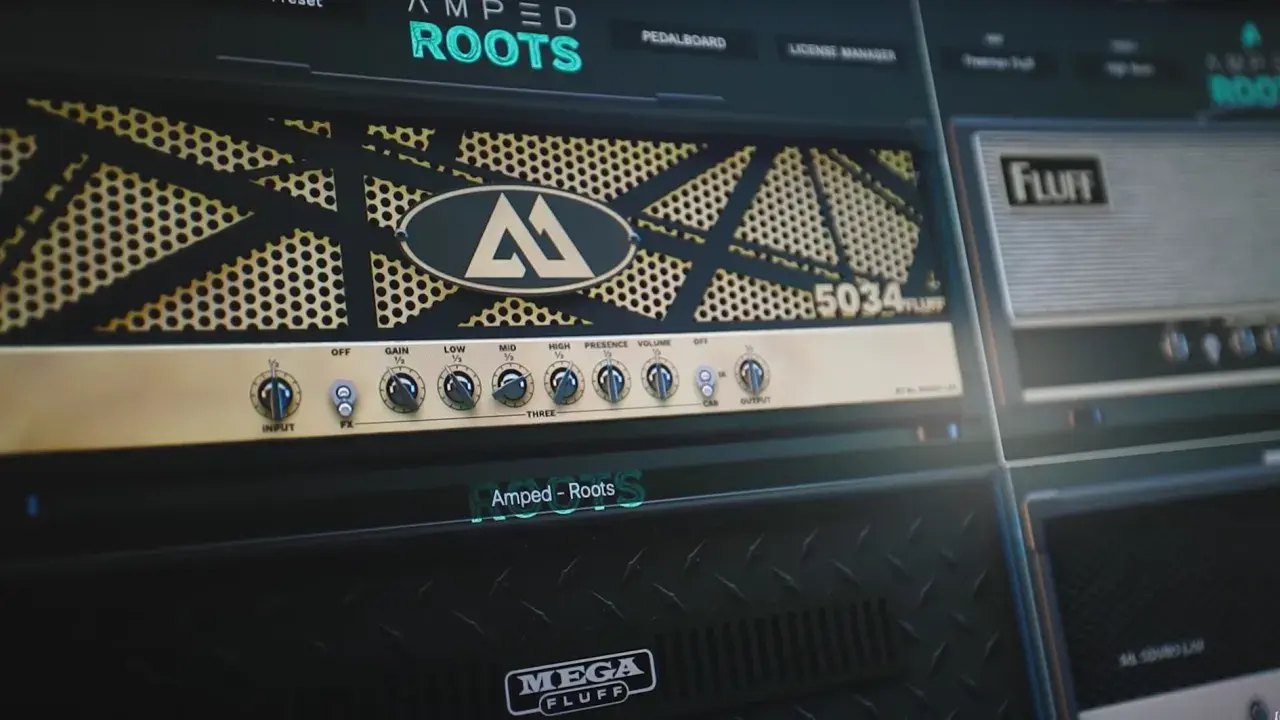
A free guitar amp sim only matters if it gets you from a dry direct input (DI) to a convincing tone without a long setup fight. Amped Roots Free is built around that idea: one focused high-gain voice, a useful cab section, and enough built-in processing to get a track moving quickly. I’m going to break down what you actually get, how I would dial it in, where it shines, and when a different free tool makes more sense.
What matters most before you install it
- The free build gives you one modern metal amp, not a watered-down trial.
- Its cab section and mic placement matter as much as the amp itself.
- The built-in gate, drive, compressor, delay, chorus, and reverb are enough for basic tracking.
- It works as a standalone app and as a plugin, so it fits both DAW and practice workflows.
- The free version is genuinely usable, but the full license unlocks more amp flavors and a bonus IR.
What the free version actually includes
ML Sound Lab treats the free build less like a teaser and more like a real starting point. That matters, because a lot of freeware amp sims give you just enough to audition the sound and not enough to finish a real part.
| Part | What you get | Why it matters |
|---|---|---|
| One amp model | 5034 Fluff, voiced for modern metal chugs | You can get a tight rhythm sound without stacking extra plugins first |
| 3D cab sim | Three cabinets, four mic choices, mic positioning, and IR loading | Most of the tone shaping happens here, not in the amp controls |
| Pedalboard | Noise gate, compressor, drive, chorus, analog delay, reverb | Enough to build a practical chain inside one window |
| Formats | Standalone, VST3, AU, AAX on Mac | It works for tracking, practice, and DAW sessions |
The standalone app is MIDI-controllable, which means an external controller can trigger functions or switch presets instead of making you click around with a mouse. I also like that the cab section can load IRs, because an IR, short for impulse response, is basically a recorded cabinet-and-microphone snapshot that often changes the final sound more than the amp gain does. That makes the free build feel less like a demo and more like a complete, narrow tool. Once you know what is inside, the real question is how to steer it into a tone that works in a mix.
How I’d build a usable tone fast
There are two mistakes people make with free amp sims: they dime the gain, and they start EQing before they know what the cabinet is doing. I would do the opposite. The fastest route is a clean DI, modest gain, and careful cab and mic choices.
- Record or import a clean DI that peaks around -12 to -6 dBFS before the plugin.
- Set the amp gain lower than feels natural. For heavy rhythm work, more gain usually makes the tone smaller, not bigger.
- Use the drive pedal as a boost, not as a second distortion stage. A little tightening goes a long way.
- Move the virtual mic before reaching for EQ. Small shifts from the speaker center to the edge can change the upper-mid bite more than a plugin EQ.
- If the stock cab feels wrong, load an IR you already trust. That one move often changes the plugin from "okay" to "ready."
The useful rule here is simple: the amp gives the attitude, but the cab gives the recordable tone. That is why I would spend more time on speaker choice and mic placement than on a dozen amp knobs. If that part is right, the rest becomes much easier to judge. That also sets up the next question: where does this plugin really fit, and where does it start to feel narrow?
Where it shines and where it stops being enough
This is the part most people skip, and it is the part that saves time. The free build is strongest when you want a focused heavy tone quickly; it is weaker when you need a whole palette of sounds from one plugin.
- Best fit: modern metal, hardcore, djent-adjacent rhythm parts, demo sessions, late-night practice, and quick pre-production.
- Also useful for: users who want a simple standalone app instead of opening a DAW just to rehearse or audition riffs.
- Less convincing for: sparkling clean tones, vintage breakup, and projects that need several clearly different amp characters.
- Not the best choice if: you want to explore a large amp library without leaving the same ecosystem.
The limitation is not that it sounds bad. The limitation is that it is opinionated. If that opinion matches your genre, you move fast. If it does not, you will feel boxed in after a few sessions. Once that boundary is clear, the next decision is whether the free build is enough or whether the upgrade path makes more sense.
Free version versus paid unlocks and other free paths
According to ML Sound Lab, the full license unlocks three extra amp models and a bonus cab IR, so the upgrade is about range rather than a completely different engine. That is a useful distinction, because it tells you what you are actually paying for: more flavors inside the same workflow.
| Option | What it gives you | Why someone picks it | Tradeoff |
|---|---|---|---|
| Free version | One amp, cab sim, pedals, standalone app | Fast, zero-cost modern guitar tones | Only one core amp voice |
| Full license | Three extra amps and Fluff's personal cab IR | More range inside the same workflow | Costs money, so it only makes sense if you like the core sound |
| Capture-based free modelers | Large third-party capture ecosystem | Maximum variety and community content | More setup and more decision fatigue |
If I were choosing with my own money, I would treat the free version as an audition, not a placeholder. If the core tone feels right, the upgrade is about convenience and extra flavors, not rescuing a broken sound. If the core tone does not click, the right move is usually to try a different modeling approach rather than force it. With that tradeoff in mind, the last step is turning the plugin into something that actually sits in a song.
A workflow that gets a mix-ready sound
Once the plugin is behaving, the last step is making it sit in a song. I usually start with arrangement first, tone second, and polish last. If the guitars are fighting the bass or cymbals, no amp sim will magically fix that.
- Double-track rhythm guitars instead of piling on processing. Two solid performances beat four over-processed ones.
- High-pass cautiously. A start point around 70 to 90 Hz is common for heavy guitars, but I always check it against the bass and kick.
- Low-pass the top end if the tone feels fizzy. Around 8 to 10 kHz is a sensible first pass, then I adjust by ear.
- Use the plugin’s own cab and IR options before adding another EQ layer. Fewer plugins usually means fewer accidental phase problems.
- Print or freeze the sound when it is close. Endless tweaking is usually a sign that the performance or arrangement needs attention.
My bias is practical here: a good DI, a sensible cab choice, and restrained post-EQ usually do more for the final record than any amount of knob turning inside the amp. If you keep those habits in place, the plugin stops feeling like freeware and starts behaving like a real working tool.
My bottom line for a free modern-metal rig
I would recommend this plugin to anyone who wants a no-cost, modern-gain starting point that does not waste time. I would not recommend it as your only guitar solution if you record a wide range of genres, because the narrow focus is exactly what makes it fast.
If you want one reliable heavy tone and a simple workflow, the free build makes sense. If you need broad amp variety, a more capture-heavy ecosystem, or cleaner genre coverage, you will outgrow it sooner. Either way, the useful takeaway is the same: your DI, your cab choice, and your performance still do most of the heavy lifting. If that matches your workflow, it is easy to justify the download and hard to overcomplicate it.