The short version of the payout math
- $300 to $500 gross is the most useful planning range for 100,000 Spotify streams.
- Spotify does not pay a fixed per-stream rate, so the same stream count can land differently from month to month.
- A US-heavy, premium-heavy audience usually earns more than ad-supported or lower-value geographic mixes.
- Distributor fees, label deals, collaborator splits, and taxes can cut the take-home sharply.
- For most artists, 100,000 streams is a real milestone, but not a full-time income stream.
How much 100,000 Spotify streams usually pay
If I were giving a practical estimate in 2026, I would budget $300 to $500 gross for 100,000 streams on Spotify. That is the cleanest working range for planning, even though the exact payout can sit outside it depending on audience mix and royalty structure.| Planning band | Rough gross from 100,000 streams | When it tends to happen |
|---|---|---|
| Conservative | $200 to $300 | More ad-supported listening, weaker monthly streamshare, or a lower-value geographic mix |
| Typical | $300 to $500 | A mixed audience with a healthy share of premium listeners, especially in the US and other high-value markets |
| Strong month | $500+ | Premium-heavy listening, favorable country mix, and clean rights ownership |
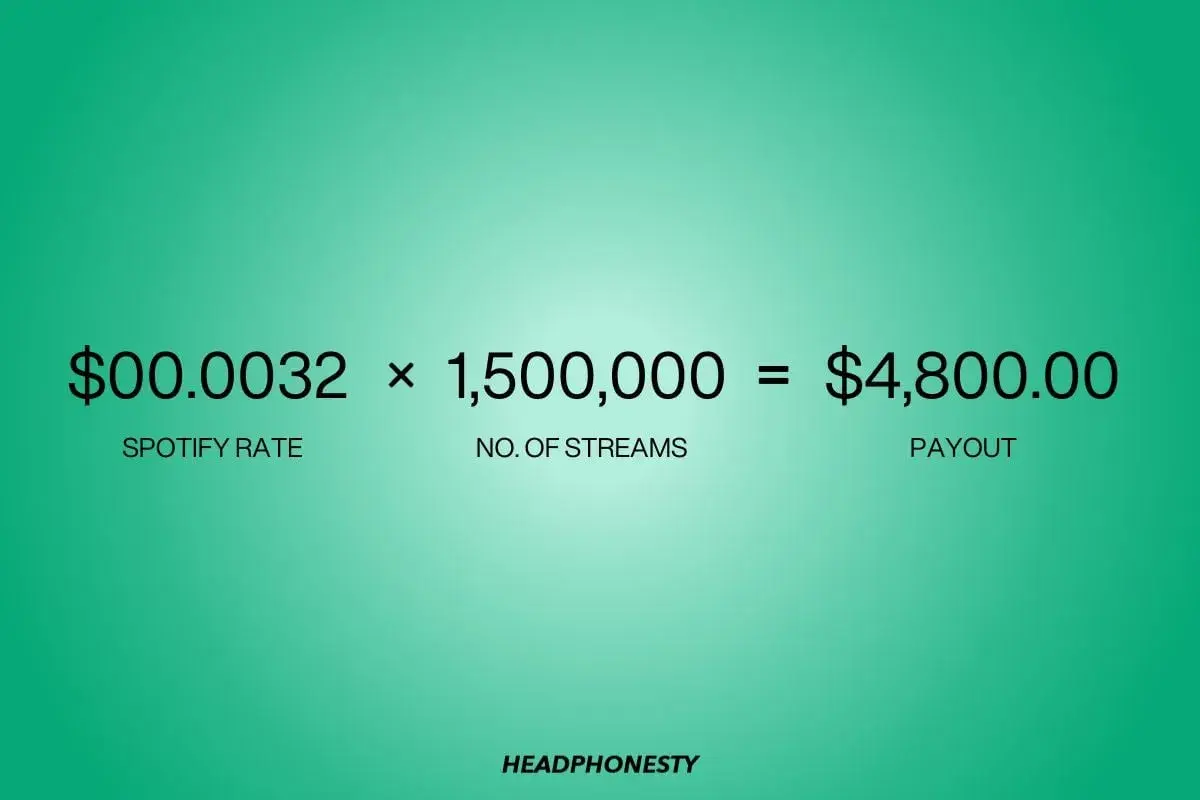
A useful mental shortcut is simple: at about $0.003 to $0.005 per stream, 100,000 plays puts you in that $300 to $500 gross zone. I use that as a planning range, not a promise, because the platform does not run on a universal sticker price.
That brings us to the part most artists miss at first. The stream count is fixed, but the economics behind it are not.

Why the payout is not a fixed rate
Spotify’s royalty model is based on streamshare, which means the monthly revenue pool is divided according to your share of total listening rather than a published per-play price. In plain English, the service does not pay every stream the same amount, and the number changes with the makeup of the month.
Three things usually move the payout the most:
- Listener type - premium subscribers tend to generate more value than ad-supported listeners.
- Listener geography - a US-heavy audience usually pays better than a catalog spread across lower-value markets.
- Monthly platform mix - your share of the total platform pool changes from month to month, even if your stream count looks similar.
This is why two songs can both hit 100,000 streams and still produce different royalty checks. One song may be concentrated in premium markets, while the other is fed by ad-supported traffic or a broader global mix. The stream count is the headline, but the audience profile is what moves the money. Once that clicks, the next question is obvious: who actually gets to keep those royalties?
What you actually keep after fees and splits
Headline numbers are useful, but they are not the same as take-home pay. Streaming money can move through a distributor, a label, a co-writer split, a producer agreement, and sometimes a separate publishing collection path before it reaches the artist.
Spotify’s current monetization rules also matter here: recorded tracks need to clear a 1,000-stream threshold in the previous 12 months before they generate recorded royalties. That is not a problem at 100,000 streams, but it reminds you that the platform is paying rights holders, not casually handing out cash to every upload.| Deal structure | What 100,000 streams might mean in practice | Why |
|---|---|---|
| Independent artist, owns master and publishing | Close to the full gross amount, minus distributor fees and taxes | This is the cleanest path because fewer parties are taking a cut |
| Independent artist with collaborators | Often 50% to 80% of the gross, depending on the split | Co-writers, producers, and featured artists may be contractually owed a share |
| Signed artist with label recoupment | Can be much lower, and sometimes delayed until recoupment is cleared | The label may recover advances, marketing, or production costs first |
| Songwriter without the master | Only the publishing side, which is a smaller slice of the total | The song can earn well while the recording side goes elsewhere |
If you own everything and your release is cleanly set up, the gross number matters a lot more. If you are in a split or label relationship, the same 100,000 streams can feel far less impressive on your bank statement. That leads straight into the details that make one release outperform another even when the stream count looks identical.
Why the same 100,000 streams can pay very differently
I would never judge streaming income by stream count alone. Two releases can both hit 100,000, but one can be worth materially more because of how the audience found it and who that audience is.
- Premium-heavy listeners raise value - if your audience pays for Spotify instead of using the free tier, the royalty pool is usually healthier.
- High-value markets matter - US, UK, Canada, Australia, and parts of Western Europe often outperform lower-paying regions.
- Repeat listeners improve the long tail - a track that keeps earning after the first spike is more useful than one that flashes and disappears.
- Playlist traffic is not automatically equal - algorithmic discovery can help, but a shallow skip-heavy audience usually does less for future earnings.
- Fake growth is a trap - purchased streams can distort reporting and do not build a durable fanbase.
The practical takeaway is that 100,000 streams from a real, engaged audience are worth more than 100,000 streams assembled from weak traffic. I would rather see a song earn steadily from one believable listener base than spike once and vanish. That is also why the number is best treated as a business signal, not just a payout figure.
How I would use the number in a real release plan
If I were budgeting a release around Spotify, I would treat 100,000 streams as a checkpoint, not a salary. It is enough to prove that a song is moving, but not enough to fund a serious campaign, a long tour, or a full month of living expenses unless the economics are unusually favorable.
- Use the low end of the range when forecasting cash flow.
- Assume the net number will be lower after distributor fees, splits, and taxes.
- Look at listener geography before you assume the result will repeat.
- Track saves, repeat listens, and playlist adds because they predict future revenue better than one spike does.
- Ignore any shortcut that promises artificial streams or guaranteed chart movement.
That is the lens I trust most: not “How much did the song make this month?” but “Is this song building a listener base that can compound?” If the answer is yes, 100,000 streams is useful. If the answer is no, the number is flattering but thin.
Why the stream count matters more for momentum than for rent
The biggest mistake I see is treating stream count like a paycheck instead of evidence. A song with 100,000 plays tells you something important: people found it, listened long enough to count it, and returned often enough to push it across a meaningful threshold. That is the part worth paying attention to.
What I would remember is this: the cash from 100,000 Spotify streams is usually modest, but the signal can be strong. If the audience is real, the rights are set up properly, and the listeners are concentrated in valuable markets, the same stream count becomes much more useful than the raw number suggests. In other words, I look at the payout to understand the month, but I look at the audience to understand the career.
