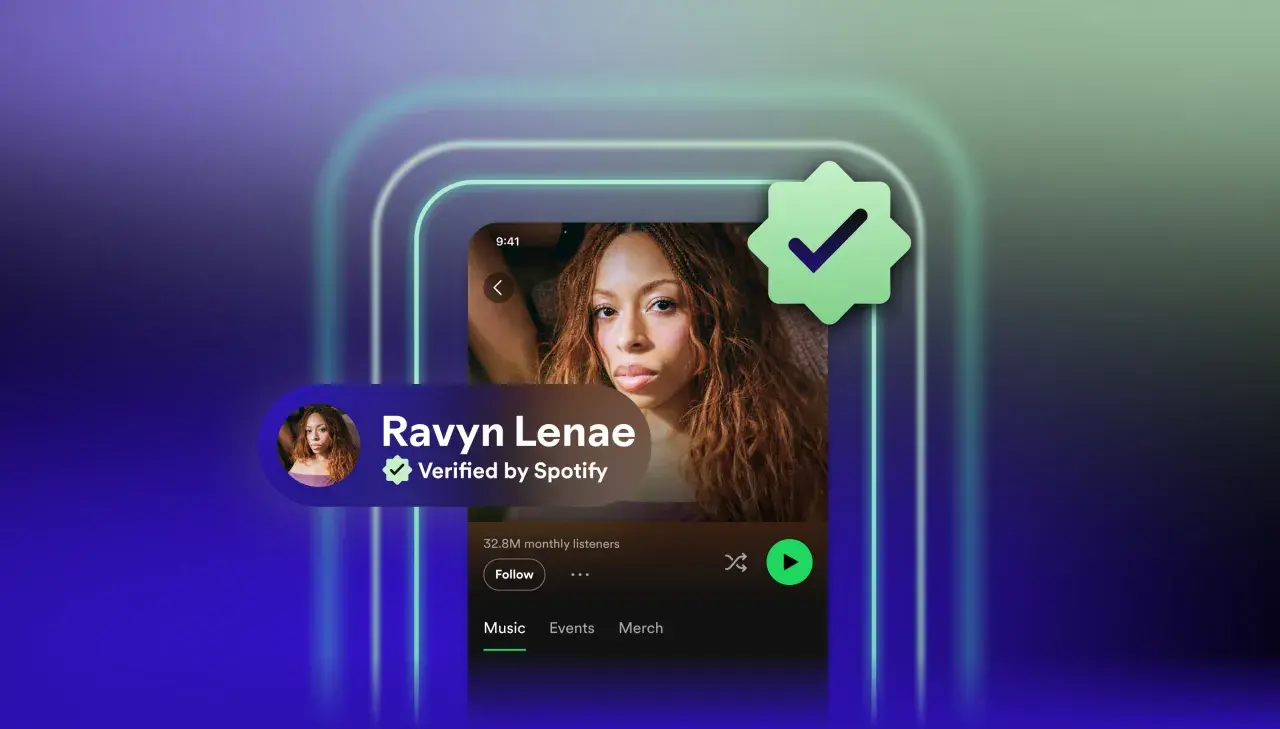
This guide explains how to get verified on Spotify without the usual myths. In 2026, Spotify is shifting the old blue checkmark toward a Registered Artist label, so the real job is not chasing a badge but proving that a real, actively managed artist profile sits behind the music. I’ll walk through the actual process, the signals Spotify looks at, and the profile moves that genuinely help.
The fastest route is a claimed profile with real audience signals
- Your artist profile is created automatically when music is first delivered through a distributor, then claimed in Spotify for Artists.
- Spotify reviews profiles over time, so there is no instant approval path or paid shortcut.
- Verified by Spotify is being rolled into Registered Artist in 2026, but the meaning is still about trust and active management.
- Listener activity, policy compliance, and real-world artist signals matter more than vanity metrics.
- Artificial streaming, broken metadata, and a thin profile can slow the process or hurt your credibility.
What Spotify verification means in 2026
Spotify began rolling out the change on January 28, 2026. The old verified checkmark is being relabeled as Registered Artist in the About section, but the meaning stays close to the original idea: Spotify is signaling that the profile is claimed and actively managed. What it does not do is magically raise royalties, improve discovery on its own, or unlock special access to Spotify for Artists tools.I think that distinction matters because a lot of artists still treat verification like a trophy. It is better understood as a trust marker. If Spotify can clearly connect the music to a real artist, a real team, and a real public presence, the profile has a much stronger case for the label.
| Profile state | What it means | Practical takeaway |
|---|---|---|
| Unclaimed profile | Spotify has created the page, but the artist or team does not control it yet | You need to claim it before you can shape the profile or strengthen credibility |
| Claimed profile | The artist team manages images, bio, links, and analytics in Spotify for Artists | This is the baseline every serious artist should reach first |
| Verified by Spotify / Registered Artist | Spotify has recognized the profile under its authenticity review | The badge or label may appear, but it is still a signal, not a growth hack |
Once that distinction is clear, the next step is making sure you actually control the profile and have the right artist data attached to it.
Claim the profile before you worry about the badge
Spotify does not let artists build a profile from scratch in the way they would create a social account. According to Spotify for Artists, the artist profile is created automatically when music is first uploaded to Spotify, which means the process starts with distribution, not with the badge. If you want to claim the page, you need the correct artist link or URI and access to Spotify for Artists.
- Deliver your music through a label or distributor. Spotify requires music to come through licensed delivery partners.
- Get your artist link or URI from the distributor. If the release is not live yet, the distributor can usually supply it once the music has been delivered.
- Submit the claim in Spotify for Artists and add links to your website or social profiles so Spotify can verify your identity.
- If your release is upcoming, use the artist link and, when needed, the UPC or EAN for the release so the right profile is connected before launch.
- Wait for the manual review. Approval can take a few days, and only one active claim request can exist per profile at a time.
If someone else already claimed the profile, the fix is not to start over. You need to ask the current admin for an invite or sort out the claim on that existing team. That is the unglamorous part of the process, but it is usually the part that determines whether everything else works cleanly.
What Spotify looks for before the badge appears
Spotify Support says reviews roll out on an ongoing basis, which is another way of saying there is no instant-submit path for a verification badge. Spotify looks for a combination of public signals that suggest a real artist is behind the profile, and those signals are stronger when they show up consistently rather than all at once.
Consistent listener activity
This is the signal most artists underestimate. In practice, Spotify is not looking for one lucky spike. It is looking for sustained, intentional interest, the kind that comes from listeners searching for the artist, returning to the profile, saving tracks, and following along over time. A profile with steady engagement usually looks more credible than one that exploded briefly and went quiet.
Good standing with platform policies
Spotify also checks whether the artist and their content comply with platform rules. That means the basics still matter: properly licensed uploads, clean metadata, and no behavior that would put the account into a questionable category. I would not think of this as a technicality. A profile can look active and still be disqualified by policy issues that are entirely avoidable.
Signals of a real artist presence
Spotify looks for an identifiable artist both on and off the platform. That usually means linked social accounts, concert dates, merch, a consistent visual identity, and a profile that does not feel empty or half-finished. The more your public footprint resembles an actual working artist, the easier it is for Spotify to trust the profile.
Read Also: Spotify Genres - How They Work & How to Use Them
AI use and authenticity
This part matters in 2026. Spotify says profiles that primarily represent AI-generated or AI-persona artists are not eligible at launch, but artists who use AI tools responsibly as part of their creative process can still be eligible if they present themselves authentically. That is a useful distinction. The issue is not whether AI touched the workflow. The issue is whether the public-facing artist is real, identifiable, and honestly represented.
Spotify may also consider artists who have made important contributions to music culture and history, or those building cultural momentum, even if they have not yet hit the usual listener threshold. That is a narrower path, but it explains why the badge is not purely a numbers game.
Those signals only work if the profile looks alive, which is where the day-to-day profile work matters.
How I would strengthen an artist profile for review
If I were preparing a profile for verification, I would focus on making the page feel complete, current, and hard to misread. The point is not decoration. The point is to remove doubt.
- Use one consistent artist name everywhere. Mismatched spelling across releases, socials, and distributor metadata creates confusion that works against you.
- Fill out the visuals. A clear profile image, header image, and a bio help the page look like it belongs to a working artist, not a placeholder.
- Link your real presence. Website, Instagram, TikTok, YouTube, and any active artist channels should all point to the same identity.
- Add live proof. Concert dates and merch listings are strong real-world signals because they show that the artist exists beyond Spotify itself.
- Keep releases coming. A regular release rhythm tells Spotify that the project is active, not abandoned.
- Pitch upcoming music early. Spotify recommends giving yourself at least 7 days before release if you want time to pitch a song and get the profile ready.
- Stay away from artificial streaming. Fake traffic can damage trust and, in some cases, trigger data and royalty problems that outlive the short-term bump.
I would also clean up the less visible details. Release metadata should be consistent, artist credits should match reality, and the profile should never feel like it was assembled in a rush. Those are small things until they are the reason Spotify hesitates.
The mistakes that usually delay the result
Most artists do not miss verification because they lack talent. They miss it because they create friction for the system that is supposed to recognize them.
- Expecting an instant badge. Claiming the profile and being recognized by Spotify are not the same event.
- Using fake streams or paid growth services. Anything that inflates numbers without real listener intent can damage credibility.
- Leaving the profile unfinished. A blank bio, missing images, and no social links make the page look temporary.
- Uploading with inconsistent metadata. Different spellings, wrong credits, or mismatched artist names make it harder for Spotify to trust the profile.
- Letting the wrong team control the page. If the profile is already claimed by someone else, you need to resolve access, not keep rebuilding the same request.
- Assuming AI automatically disqualifies the artist. That is too blunt. Spotify cares about whether the artist is authentic and clearly represented.
The pattern here is simple: the more ambiguous the profile looks, the longer the path becomes. The more clearly it reads as a real, active artist project, the easier it is for Spotify to place trust in it.
What to do while you wait for the Registered Artist label
Even when the profile is properly claimed, the label may not show up immediately. I would not waste energy trying to force the timeline. I would use that time to make the page and the release strategy stronger.
- Check the artist dashboard for real engagement trends instead of staring at the badge.
- Keep your next release cycle moving so the profile continues to show activity.
- Refresh bios, images, merch, and concert listings whenever something changes.
- Watch for duplicate profiles or incorrect artist mappings and fix them quickly.
- Make sure the team handling the release understands the artist link, the metadata, and the distributor workflow.
That is the part most artists miss: verification is not the finish line, it is a confirmation that the profile is already doing the right things. If the page is claimed, the identity is consistent, and the audience is real, the badge or Registered Artist label tends to follow the work rather than replace it.