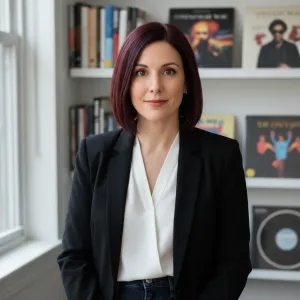
Key facts that explain why her name still matters
- She is a Swedish singer-songwriter and producer whose career bridges solo artistry and mainstream pop songwriting.
- Her solo releases, including I Am Noonie Bao and the Noonia EP, show a more personal and indie-leaning side of her craft.
- Spotify for Artists lists 148 songs written, which reflects how deep her catalog runs beyond the singles most listeners know.
- Her writing shows up in major pop moments such as Stay, Never Be the Same, Let You Love Me, and Apple.
- The through-line is strong melody, emotional clarity, and a knack for shaping songs that feel immediate without sounding generic.
- If you want to understand her quickly, start with one solo track and one major co-write, then compare how differently she uses the same instincts.
Who Noonie Bao is and why pop keeps calling her back
Noonie Bao is the kind of artist whose name keeps surfacing in credits because she solves a very specific pop problem: how to make a song feel emotionally direct while still sounding polished enough for a wide audience. Born in Stockholm, she came up as a singer first, then built a reputation as a writer and topliner whose ideas travel well across very different production styles. I find that split fascinating, because it usually tells you a lot about how a writer thinks under pressure.
According to Spotify for Artists, she has 148 songs written, and the range matters as much as the number. Her catalog reaches from glossy radio pop to more left-field electronic work, with collaborators that include Charli XCX, Zedd, Camila Cabello, Rita Ora, and Avicii. That breadth is the real clue: she is not just a feature vocalist or a name tucked into liner notes. She is part of the songwriting machinery that shaped a good chunk of modern pop.That also explains why her career stays relevant even when she is not the loudest person in the room. The next question is what her solo work reveals about the writer behind those bigger records.
Her solo records show where the instincts come from
Before the bigger co-writes took over public attention, Noonie Bao released music that feels more personal and exposed. I Am Noonie Bao arrived in 2012, followed by the Noonia EP in 2015 and later singles such as “Reminds Me” and “Sorry Not Sorry.” Those releases matter because they show the original shape of her taste: intimate vocal phrasing, clean hooks, and songs that feel carefully built rather than overworked.
| Release | What it sounds like | Why it matters |
|---|---|---|
| I Am Noonie Bao | Indie pop and folk-leaning songwriting with a soft, personal edge | It presents her as an artist with a clear voice before she became widely known as a writer for others. |
| Noonia | Sleeker, more pop-forward production with sharper chorus writing | It shows her moving toward the sound world that later made her such a useful collaborator. |
| “Reminds Me” | Minimal but emotionally focused pop | It demonstrates how she can make a track feel small in scale without losing melodic impact. |
| “Sorry Not Sorry” | More streamlined and contemporary | It reflects the modern pop instincts that also show up in her co-writes. |
I think this is the part of her catalog most listeners skip, and that is a mistake. The solo records do not just show a separate side project; they explain why her songwriting lands so cleanly in other people’s hands. She already understood how to keep a lyric specific and a chorus easy to remember. From there, it was only a short step to the bigger pop stage.
The songs that explain her reputation fastest
If you want the quickest read on her impact, go straight to the songs where her writing meets a larger pop machine. These tracks show how well she can adapt without losing her fingerprint. Some are built around her own voice, while others rely on her ability to shape a topline that stays in your head long after the production has moved on.
| Song | Why it matters | What to listen for |
|---|---|---|
| I Could Be the One | A breakthrough dance-pop moment that helped introduce her to a wider audience | Listen for the contrast between the club-ready production and the vulnerable vocal line. |
| Stay | One of her biggest mainstream credits, with well over 1.4 billion streams listed on Spotify | The hook is immediate, but the emotional lift is what makes the chorus stick. |
| Never Be the Same | A huge pop crossover record with more than 1.1 billion streams on Spotify | Notice how the chorus feels both confessional and engineered for repetition. |
| Let You Love Me | A radio-friendly pop ballad with nearly 600 million streams on Spotify | It shows how she handles restraint, not just big hooks. |
| Apple | A recent-era credit that keeps her in the center of current pop conversation | It proves she is still writing into the present tense, not just living off older hits. |
What I like about this set is that it covers several different pop modes without turning into a museum display. There is dance-pop, radio pop, confessional pop, and a newer, sharper Charli XCX lane. If you only hear one of these tracks, you get a fragment. If you hear all five, you start to see a writer with range, not just a lucky credit sheet.
What her writing style actually sounds like
The easiest way to describe her style is this: she writes hooks that feel emotionally inevitable. That sounds simple, but it is harder than it looks. A lot of pop writing can be technically correct and still feel disposable. Her songs usually avoid that trap because the melody and the lyric seem to arrive together, as if the song had been waiting for the right shape rather than being assembled from parts.
- She favors clean melodic lines that listeners can catch on the first pass.
- She keeps lyrics direct, often using plain language instead of overdecorated imagery.
- She leaves room for the production, which makes the song feel bigger without sounding crowded.
- She can work in both warm and cool sonic settings, from intimate synth-pop to glossy mainstream radio.
- She understands contrast, especially when a song needs a fragile verse and a more expansive chorus.
In industry terms, she often works as a topliner, which means the vocal melody and lyric are developed over an instrumental track. That role can sound narrow on paper, but in practice it is one of the most decisive parts of a record. A good topline can make a song feel finished in seconds; a weak one leaves the production stranded. Her catalog is a strong case for the first outcome.
There is also a reason her work sometimes feels almost invisible in the best sense. When the song is working, you notice the chorus first and the craft second. That is not a lack of identity. It is usually the mark of someone who knows how to make a record function on contact. With that in mind, the smartest way to approach her music is to build a listening path instead of sampling randomly.
Where I would start if you want the full picture
If I were building a quick introduction for someone new to her catalog, I would not start with a playlist that tries to cover everything at once. I would choose a few tracks that show different jobs she can do: lead artist, collaborator, and hit writer. That gives you a clearer sense of range than a scattershot greatest-hits approach.
| Listener goal | Best starting point | Why this is the right entry |
|---|---|---|
| You want to hear her own voice first | “About to Tell” | It captures the early emotional tone of her solo work without too much studio gloss. |
| You want the clearest mainstream hook | “Stay” | It is one of the cleanest examples of her ability to build a chorus that lands fast. |
| You want a crossover pop record | “Never Be the Same” | It shows how she helps turn personal tension into a huge radio-ready song. |
| You want to hear her current relevance | “Apple” | It connects her to a newer pop language and proves she is still part of the conversation. |
| You want the bridge between solo and collaborator | “Reminds Me” | It sits between the intimate and the polished, which is where her identity becomes easiest to read. |
For me, that path works because it shows the continuity in her work. The voice may shift, the collaborators may change, and the production may move from folk-pop to club pop, but the underlying instinct stays the same: write something memorable, honest, and structurally solid. That is exactly why her catalog rewards attention.
Why her career still matters in 2026
Noonie Bao is a useful reminder that modern pop is often built by writers whose names are less visible than their impact. Her career has moved from solo releases to major co-writes without losing a clear melodic identity, and that is harder to do than people assume. A lot of artists can write one strong song in one lane. Fewer can move between indie-leaning personal tracks and global pop singles while still sounding like the same creative mind.
What I take from her catalog is simple: the best pop writing does not need to shout to be influential. It needs to be durable. Her songs have that quality, whether they are carried by her own voice or filtered through a bigger star. If you care about how contemporary pop is made, Noonie Bao is not a side note. She is part of the structure.
And if you want the most useful takeaway, it is this: start with one solo track, one hit single, and one recent credit. That small comparison tells you more about her than any single biography ever could.