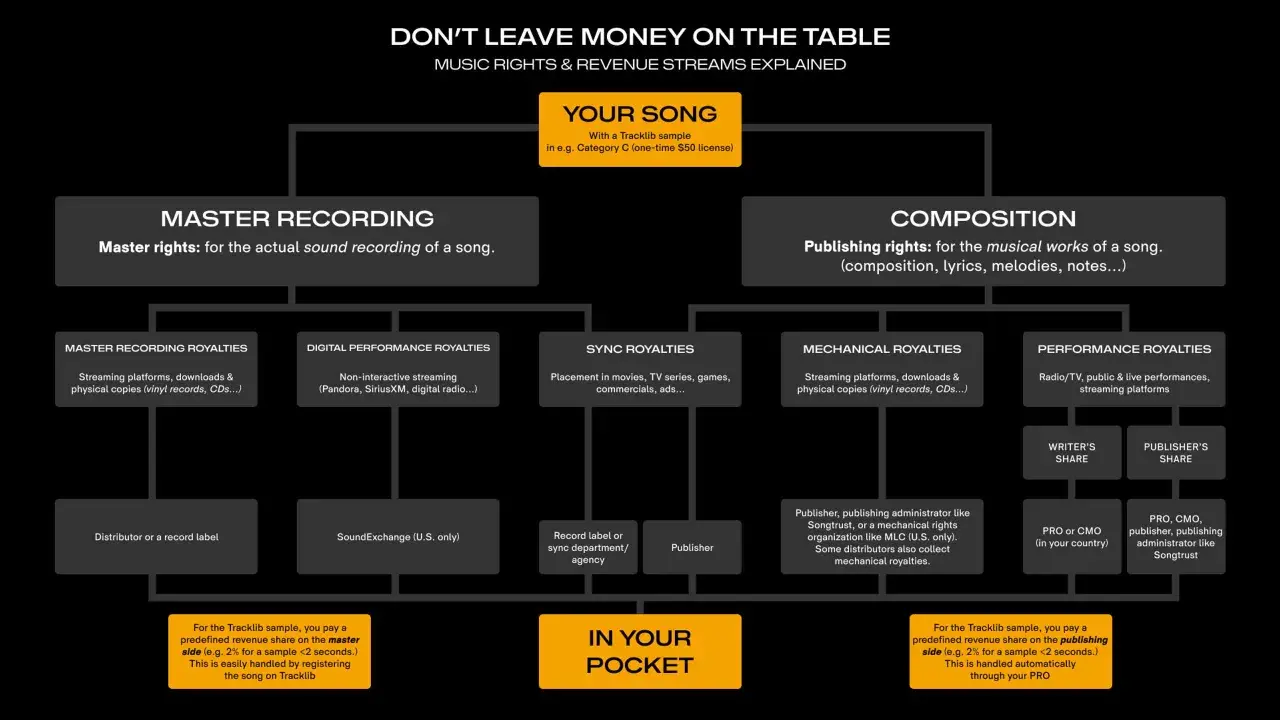
The money is split by right, not by platform
- Every release usually involves two copyrights: the composition and the sound recording.
- Different organizations handle different royalty lanes, especially PROs, The MLC, and SoundExchange.
- Performance royalties are commonly split 50/50 between writer and publisher.
- SoundExchange digital performance royalties are split 45% to featured artists, 5% to non-featured artists, and 50% to the sound recording owner.
- Clean metadata and timely registration matter as much as the music itself.
The two copyrights behind every release
When I explain music income, I always start with a basic distinction: a song and a recording are not the same asset. The composition is the underlying writing, melody, and lyrics; the sound recording is the actual recorded performance people hear on Spotify, radio, TV, or in a venue.
That split matters because royalties follow the right that was used. If someone covers your song, the new recording may belong to the cover artist, but the composition still belongs to the songwriter and publisher. If a brand uses your master in an ad, that is a separate negotiation from the publishing side. Once you see those two layers, the rest of the royalty system becomes much easier to map, because every payment is really just money attached to a specific use.
That is also why one release can generate several different revenue lines at the same time, which is where the real work begins.
The royalty streams that matter most in the U.S.
Most confusion comes from lumping everything together. I find it cleaner to separate the major royalty streams by what triggers them and who collects them.
| Royalty stream | What triggers it | Who usually collects it | What to remember |
|---|---|---|---|
| Public performance of the composition | Radio, TV, live venues, businesses, and many digital public performances | PROs such as ASCAP, BMI, SESAC, and GMR | This is the songwriter/publisher lane, not the recording lane. |
| Mechanical royalty | Reproduction and distribution of the composition in downloads and interactive streaming | The MLC for U.S. digital uses; publishers or administrators in other contexts | The current statutory rate for physical phonorecords and permanent downloads is 12.4 cents or 2.38 cents per minute, whichever is larger. |
| Digital performance royalty for the sound recording | Non-interactive digital audio uses such as satellite radio and radio-style streaming | SoundExchange in the U.S. | This lane pays featured artists and the recording owner directly. |
| Synchronization fee | A song is paired with picture in film, TV, ads, trailers, games, or branded content | Negotiated directly with the publisher and master owner | There is no blanket rate card; price depends on term, territory, media, and usage. |
| Master-use or recording income | The sound recording is licensed or monetized through a label or distribution deal | Usually the label, distributor, or master owner | Who owns the master decides who gets the check. |
Once you separate the streams, the split structure starts to make sense, which is the next thing I usually unpack.
Who gets paid and how the split usually works
For public performance royalties, the standard starting point in the U.S. is simple: 50% goes to the writer and 50% goes to the publisher. ASCAP states that split plainly, and the same practical logic is baked into how most songwriters think about performance income. If you are self-published, that second half still has to be claimed somehow, or you leave money on the table.
Sound recording royalties work differently. SoundExchange explains that digital performance royalties for sound recordings are paid 45% to featured artists, 5% to a fund for non-featured artists, and 50% to the sound recording owner. That is why a single master can pay the label, the artist, and sometimes session players or producers, depending on the paperwork and the agreements behind the recording.
I also see creators miss the producer piece. Producers, mixers, and engineers can sometimes receive a share through a Letter of Direction, but that is not automatic and it is not retroactive unless the paperwork says so. If you are working in collaboration, the safest habit is to lock the split sheet early and keep the ownership language clean before the track starts earning.
The practical takeaway is blunt: the money is not just about being entitled to it, but about being properly identified as the person who should receive it. That leads directly to the collection process itself.
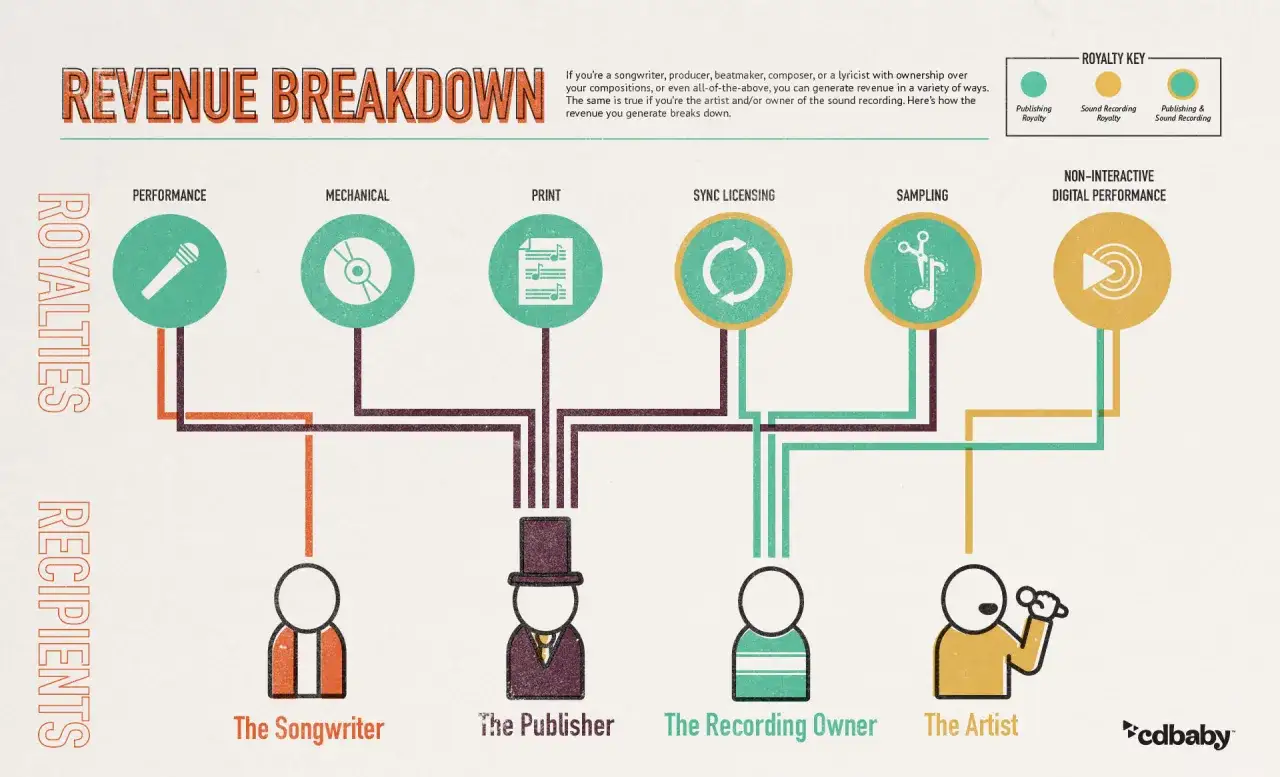
How the money moves from usage to payment
Royalties rarely move in a straight line. A service, venue, or broadcaster uses the music, reports that use in some form, and then a collective or rightsholder system tries to match the usage to the correct ownership record. Only after that matching step does the money get distributed.
- A song or recording is used.
- The user submits usage data, pays a blanket license, or both.
- The collector matches the track to the correct work, recording, and ownership splits.
- The money is allocated according to the rules of that royalty lane.
- The payment is issued on the collector’s schedule.
That timing varies by channel. SoundExchange says it pays most royalties within 45 days of receipt, and The MLC distributes digital audio mechanical royalties monthly. Performance royalties through PROs are also paid in cycles rather than per play, so a stream in January may not show up until much later. That lag is normal; the problem is when the data attached to the song is wrong.
One of the few things I would call non-negotiable is metadata discipline. If the title is inconsistent, the writer names do not match, or the publisher information is missing, the system may have no clean way to find you. In royalty administration, the fastest path to being paid is usually not a better pitch, but better data.
Where royalties go missing
Most missed income is not caused by some dramatic industry conspiracy. It is usually a chain of small failures that compound. I see the same ones over and over.
- Registering only as a writer and never setting up the publisher side.
- Forgetting to join or claim with the MLC for U.S. digital mechanicals.
- Assuming SoundExchange will find you without a proper account.
- Using split percentages that do not match the actual agreement.
- Leaving out ISRCs, writer names, publisher names, or alternate titles.
- Skipping cue sheets on film and TV work, which can block performance royalties later.
- Ignoring foreign collections and assuming U.S. registrations cover everything worldwide.
The holding periods also matter. The MLC says unmatched or unclaimed royalties from uses on or after January 1, 2021 are held for a minimum of 3 years while it works to find the right owner. SoundExchange says unclaimed royalties expire after 3 years. The exact rules depend on the collection body, but the lesson is the same: if you delay too long, the money can become harder to recover.
That is why I treat royalty setup as an operations task, not an afterthought. Once the song is out, every missing piece makes the next payment harder to trace.
A practical setup for independent artists
If I were setting up a catalog from scratch today, I would build the royalty system before I chased the next release. It does not have to be complicated, but it does have to be complete.
| Setup | Why it matters | My rule of thumb |
|---|---|---|
| Writer PRO registration | Collects public performance royalties for the composition | Do it before the track starts getting meaningful plays. |
| Publisher PRO registration | Captures the publisher half of performance income | If you are self-published, do not skip this. |
| MLC membership and claims | Collects U.S. digital mechanical royalties from eligible streaming and download services | Register every song you control and keep the data current. |
| SoundExchange account | Collects digital performance royalties for sound recordings | Set it up for every master you own or perform on. |
| Split sheet and metadata file | Prevents disputes and unmatched income later | Lock it in before release day. |
I also like to keep a simple release folder with the song title, alternate titles, ISRC, writer splits, publisher splits, master owner, feature credits, and any sync or cue-sheet documents. That sounds administrative because it is, but this is exactly the sort of boring structure that keeps a catalog profitable.
When artists ask me what actually moves the needle, it is usually not more effort in every direction. It is one clean system that lets the money find the right account without friction.
What I would lock down before the next release
If there is one practical lesson here, it is that royalties reward organization as much as creativity. A song can be strong, commercially useful, and widely played, yet still underperform financially if the registrations, splits, and ownership records are incomplete.
- Confirm every co-writer split in writing before release.
- Register the writer side and the publisher side separately where required.
- Match the same title, writer names, and ownership percentages across your distributor, PRO, MLC, and SoundExchange records.
- Keep cue sheets, sync agreements, and master ownership documents in one place.
- Audit older releases too, because dormant income often lives in the back catalog.
That is the part most creators miss: royalties are not only a creative result, they are an administrative system. The cleaner the system behind the music, the less money gets stranded before it reaches you.